
'So far as supervision is concerned, there are enough powers but to take action on public sector banks, consultation with the government is needed.'
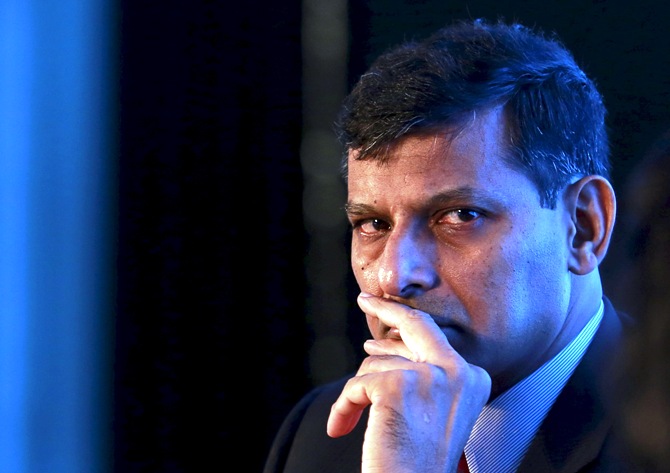
'Rajan brought in a healthy air of competition in the banking sector.'

The 30-share Sensex ended down 261 points at 27,177 and the 50-share Nifty ended down 91 points at 8,214.

S&P Global Ratings on Wednesday said Indian banks face a systemic risk as the second COVID wave will impair the performance of financial institutions in the April-September period. Stating that economic recovery remains highly vulnerable to setbacks due to COVID, particularly if fresh outbreaks trigger new lockdowns, S&P said the banking sector's weak loans will likely remain elevated at 11-12 per cent of gross loans in the next 12 to 18 months. "The second wave has front-ended weakness in asset quality," said S&P Global Ratings Credit Analyst Deepali Seth Chhabria. "Financial institutions face a strained first half amid weak collections and poor disbursements."

In a recent article, Rajan has ridiculed critics of the exchange rate policy.

RBI Governor Raghuram Rajan is regarded as credible by global financiers.

Market leaders in this line of business - New India Assurance and Tata AIG - have begun to reassess the premium on risk exposure of their portfolio in the director's and officer's liability business.
India is Asia's other bad debt headache.
RBI aiming to bring down headline number to 8% by end of this year and to 6% by the end of next year.

Macro data have little connect with indicators on the ground.

It's difficult to understand if GDP growth has actually improved.

The two nations share a problem of corporate debt gone bad that is so large and opaque.
Janmejaya Sinha lays down Urjit Patel's agenda - cleaning up bank balance sheets, evaluating robustness of CPI and pushing for digitisation in financial services.

'The 5.7% growth in the April-June period is an aberration because of GST.' 'Business activity in the last 15 days of the quarter was minimal or zero.'

Park only savings that need not be touched for many years, says Devangshu Datta.

While the total disbursement of housing loans by PSBs as well as HFCs witnessed a deceleration in 2016-17, there was significant growth for the lower slabs

The Indian stock markets may turn bearish after the US Fed decides to raise interest rates.

There are also signs that the private sector investment cycle is slowly coming back, as capacity utilisation figures across industry continue to slowly creep up. A pickup in investments will front load profitability, says Akash Prakash.

'There is no difference between the earlier government and the present government.' 'They are all following the economic policy based on the Chicago School of thought.' 'This school of thought says the government should have very little role in governing the country and the majority of the work should be handed over to the private sector.' 'This has not succeeded in the US.' 'Yet, it is being tried here by people like Arvind Subramaniam, Arvind Panagariya, Urjit Patel and Raghuram Rajan.'

Hyderabad-based Andhra Bank is aiming to get a significant proportion of the state government's business, to boost its share of low-cost deposits

The passage of the Bankruptcy Code could set the stage for other important legislation that may see India undergo more economic change than all governments combined since the reforms implemented by P V Narasimha Rao in 1991-93, says Ben Merton.
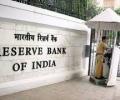
RBI is likely to have reached broadly similar conclusions since it did cut rates, presumably to stimulate activity.

For 2017-18 and 2018-19, investors are better off focusing on the quality of measures announced in the Budget and outside it rather than on the Budget numbers themselves, says T T Ram Mohan.

India's five leading wilful defaulters are Winsome Diamonds & Jewellery Ltd and associate Forever Precious Jewellery & Diamonds, Zoom Developers, Kingfisher Airlines, Beta Naphthol and Raza Textiles

These numbers show overall exposure and are not a reflection that all loans are going to be impacted.

Many in the US establishment must hope that the crisis would put the brakes on China's growing military might. Well, it ain't gonna happen, says T T Ram Mohan, who was appointed a member of the prime minister's economic advisory council on Wednesday, October 28, 2021.

Percy Mistry says things at market regulator Sebi are also in bad shape.

'We are at $2.7 trillion and 2024 is not far away.' 'The country will need to grow by 9% every year for 5 years continuously and raise the aggregate investment rate to 38% of GDP to achieve the government's target of turning India into a $5 trillion economy.' 'Given the fact that we are only growing at about 5% and our investment rates are only about 30%, it may take a number of years before we can reach that targeted level.'

RBI policy surely cannot impact agflation, in any case.
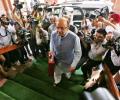
The Budget provides a reassuring message about Prime Minister Narendra Modi staying the course.
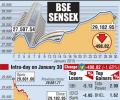
Nifty snaps 10-day winning streak

Low consumer demand, a slide in investments and troubles in the banking sector should prompt the government to recalibrate taxes and expenditure. It is also important to ramp up spending on health care and education, says CII president Sumit Mazumder.
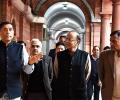
'The macro-economic stresses -- high interest rates, rupee depreciation and capital flows -- have receded now.' 'Interest rates have come down, inflation is down and the rupee has bounced back.' 'If oil prices continue at this level, there will be no vulnerability.' 'Growth is a different story.'

Under the watchful eyes of five wise men, who know the industry well, banks will not find it easy to hoodwink the system, says Tamal Bandyopadhyay.

The muted CPI inflation print at 5% earlier this week, followed by a similar WPI number released Wednesday, seems to have spurred India's central bank into action, is how the economists are reading into Reserve Bank of India governor Raghuram Rajan's 25 basis point cut in repo rate.

With Narendra Modi about to make his first Independence Day speech, there is a buzz in Delhi that Modi will make some big announcements to signal major reforms and directional shifts. But we have to wait and see if it happens, says Mohan Guruswamy.

'It is not simply demonetisation or GST, it is this government's failure to manage the financial sector crisis.'

'The entire system acted as cheerleaders to Vijay Mallya. The RBI failed, the banks failed, the auditors of the banks and Mallya failed.'

A glance back at some important events that occurred in 2018.
